The Linear Trap: From the Illusion of Growth to Structural Inequality
The linear economy we have built our prosperity upon — take, make, use, and discard — has delivered decades of growth, but also decades of hidden debt. It externalizes risks, privatizes profits, and socializes costs, creating a fragile prosperity built on a global cycle of “Three Highs”: high extraction, high pollution, and high emissions.
According to Transport & Environment (2022), Europe’s five largest oil companies — BP, Eni, Repsol, Shell, and TotalEnergies — caused an estimated €13 trillion in environmental and health damages between 1993 and 2020, costs ultimately borne by society and governments. A 2024 study by S&P Global and the Capitals Coalition further revealed US$3.71 trillion in unpriced environmental costs missing from global corporate balance sheets in 2021.
These invisible costs are not just accounting gaps, they are signs of systemic imbalance. The Global North designs the standards, sets the carbon rules, and shapes the supply chains, while the Global South bears the weight of extraction, pollution, and low-value manufacturing. This is not a geographic gap — it is a systemic failure of the linear economy.
The Circular Mindset: Reconnecting Value and Responsibility
Escaping the linear trap requires more than incremental improvements; it demands a redesign of the entire economic logic: from siloed problem-solving to systemic co-creation, where growth, innovation, and responsibility become interconnected.
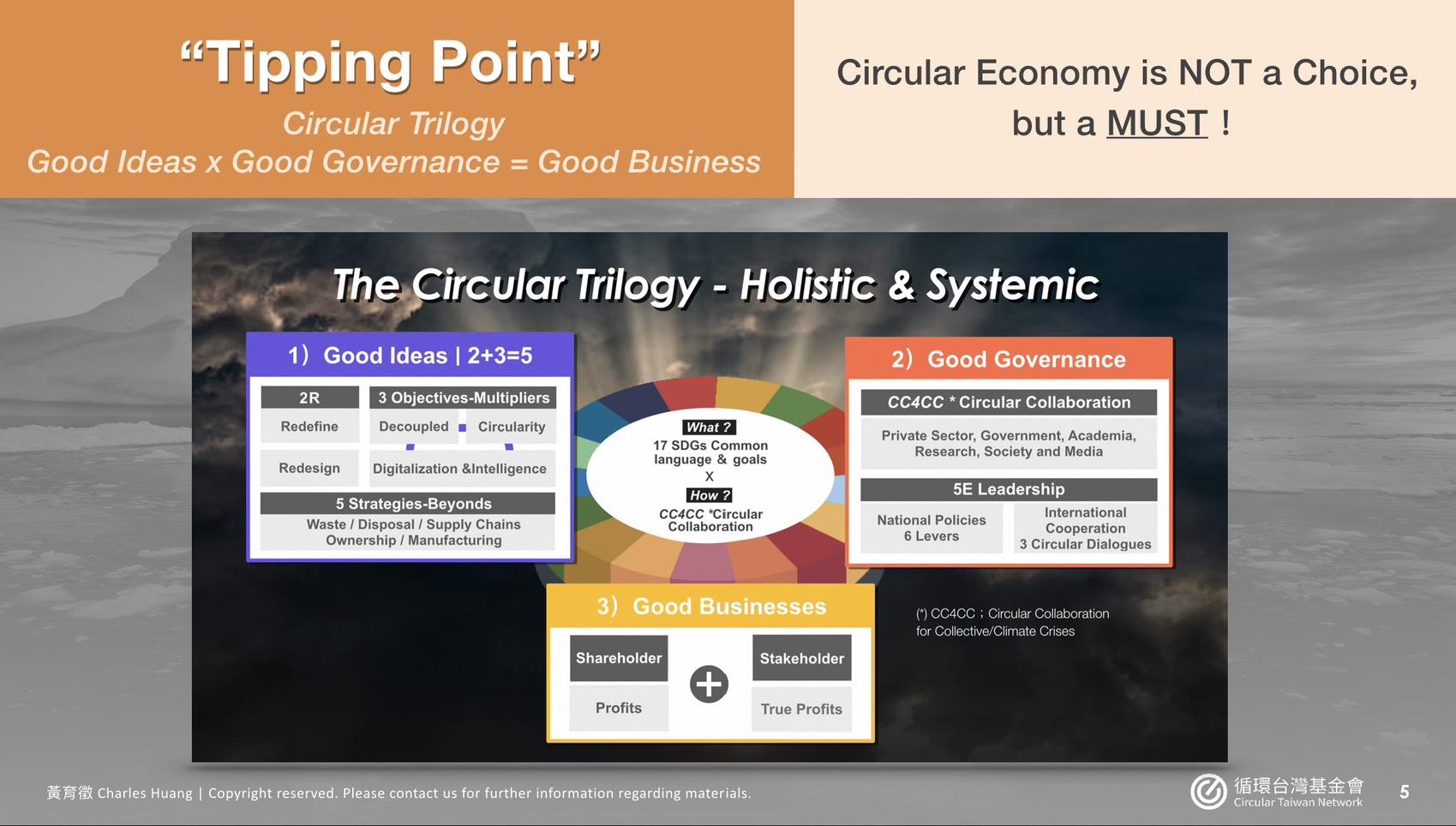
This is where the Circular Trilogy comes in — not merely a framework for circular economy, but a systemic model that integrates innovation, governance, and business into one coherent transformation path:
- Good Ideas: Redefine and redesign growth itself (the 2R approach — Redefine and Redesign). Innovation should no longer depend on destruction.
- Good Governance: Build cross-sector, cross-ministerial, and cross-border cooperation through six policy levers — Legislative Admin Reforms, Circular Procurement, Green & Circular Finance, Circular Taxation, R&D Support Technology And Digital, and Human Resources Training, and three global dialogues that embed circularity into international negotiation, carbon responsibility, and resilient accounting.
- Good Business: Internalize positive externalities — environmental restoration, health, inclusion — as true profit, turning invisible value into visible prosperity.
This is the essence of Circular PPPs (Public–Private–Partnerships), where doing good and doing well walk the same path.
When good ideas meet good governance and become good business (Circular Trilogy), the circular economy stops being an aspiration, it becomes an economic system of shared prosperity.
Beyond Current Frameworks: Three Structural “Beyonds”
The global circular economy movement is maturing, yet many existing frameworks remain fragmented, regionally centered, or finance-heavy.
The European Union’s Circular Economy Action Plan (CEAP, 2020) and related tools such as the EU Taxonomy, CSRD, and SFDR have laid a crucial foundation for sustainable finance and industrial transformation. But they remain inward-looking, driven largely by compliance and market protection. Instruments like the Carbon Border Adjustment Mechanism (CBAM) and Eco-design Directive strengthen the EU’s internal resilience but risk widening the global divide instead of closing it.
Meanwhile, global initiatives from platforms like the World Economic Forum and Ellen MacArthur Foundation have advanced the narrative of circularity, but often lack integration and scalability. Many efforts remain project-based or voluntary, disconnected from fiscal and trade systems that could embed circular logic at scale.
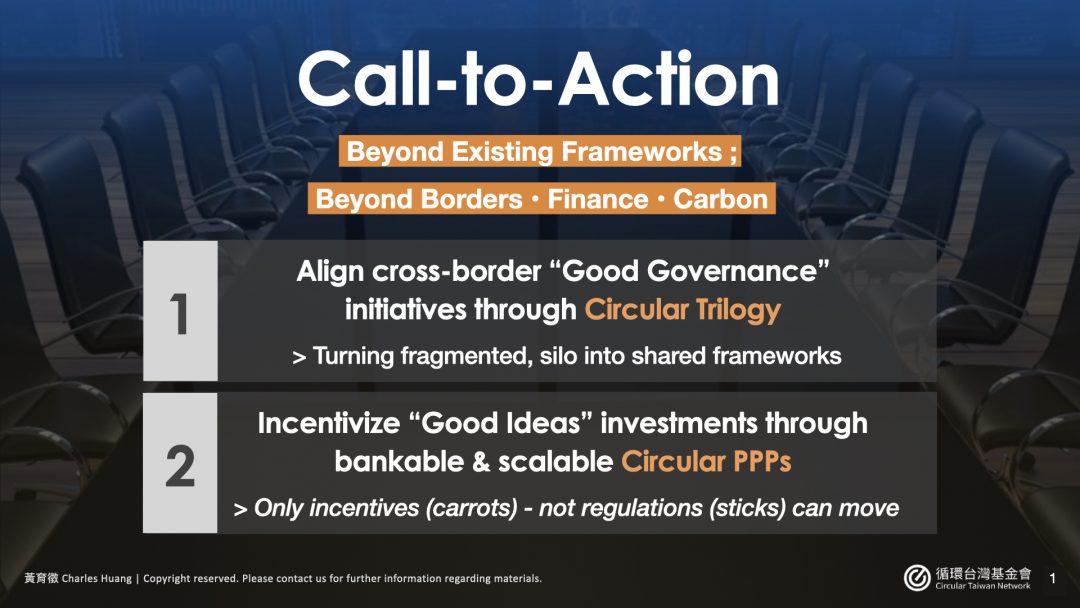
The Circular Trilogy offers a pathway to overcome these limitations through “Three Beyonds”:
- Beyond Finance — The EU approach centers on disclosure and green finance. The Circular Trilogy integrates policy, industry, and finance as one system. Turn regulation from a compliance burden into a transformation incentive.
- Beyond Europe — Move from regional protection to global co-responsibility. Through CC4CC (Circular Collaboration for Climate Crisis), the Circular Trilogy promotes true Global North–South partnerships that bridge carbon borders and fragmented supply chains.
- Beyond Carbon — The Circular Trilogy broadens the agenda from climate to civilization. Address the Seven Collective Crises (7C), resource depletion, pollution, climate, energy, health, inequality, and geopolitics — recognizing that sustainability must be systemic, not sectoral.
In short, while the EU builds a European framework for circularity, the Circular Trilogy envisions a global framework for cooperation and regeneration.
Taiwan’s Strategic Role: A Bridge Between North and South
The UN’s 17 Sustainable Development Goals tell us where we need to go; the Circular Trilogy and CC4CC tell us how we can move together.
At the intersection of global supply chains, digital governance, and industrial innovation, Taiwan is uniquely positioned to become the bridge connecting North and South, present and future.
With digitalization as its catalytic engine and circular thinking as its roadmap, Taiwan demonstrates how a small island can play a pivotal role in the global regeneration movement — not by scale, but by system innovation and partnership.
The Circular Trilogy is not a theory — it is a practical compass for action. It reminds us that:
A good idea must be supported by good governance;
and good governance must enable every good idea to become good business.
This is Taiwan’s contribution to the world, a bridge toward a resilient, inclusive, and circular future.
作者:黃育徵(循環台灣基金會董事長)
原文刊載於獨立評論2025/10/20 循環三部曲:連結全球南北,打破線性經濟的迴圈