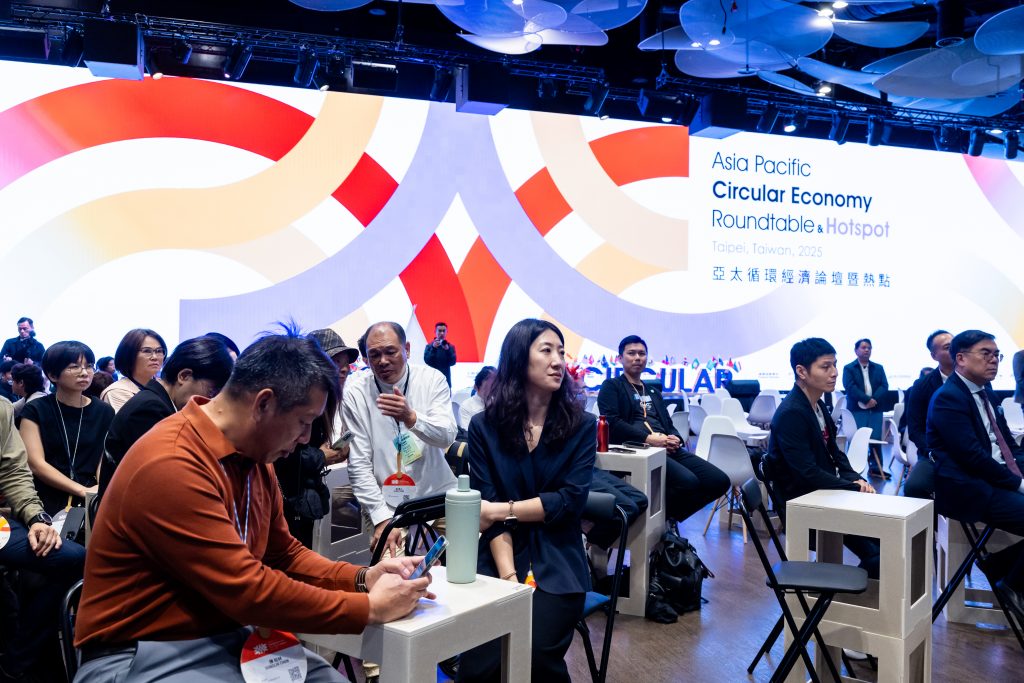
During the Asia Pacific Circular Economy Roundtable & Hotspot 2025 (APCER & Hotspot 2025), international media outlets from diverse national, industrial, and governance backgrounds offered in-depth coverage of this major circular economy event hosted in Taiwan. Their reporting went beyond the scale of the forum or policy announcements to address a more fundamental question: in a region as diverse as the Asia-Pacific, why is Taiwan’s circular economy experience worth learning from?
These observations—from technology, sustainability, industry, and policy-oriented media—provide a perspective that is less commonly seen in domestic discussions: viewing Taiwan’s role and value through an international lens.
Starting from “Design”: How Taiwan Turns Circular Economy into a Shared System Language
Many international reports highlighted the forum’s most distinctive feature: its clear and coherent structure. Rather than focusing on a single industry or isolated technological solutions, the Circular Trilogy—Good Ideas, Good Governance, and Good Business—was widely recognized as a shared language capable of bridging borders, sectors, and policy systems.
For countries still operating primarily within a recycling-oriented paradigm, Taiwan’s contribution lies in translating the circular economy from a slogan into a system design challenge. This includes embedding principles such as modularity, traceability, and recyclability at the product design stage, and aligning policy, finance, and market mechanisms to support those design choices.
Several international commentators noted that this structured narrative reframes the circular economy from a concept led by advanced economies into a flexible transition framework that Asia-Pacific countries can adapt according to their own conditions.
From Operational Reality: How Technology and Manufacturing Demonstrate That Circularity Is Not Idealism
In coverage by technology and industry media, the semiconductor and ICT sectors emerged as key focal points. Rather than emphasizing corporate pledges, journalists examined how circular principles are actually being implemented within highly complex and competitive supply chains.
From zero-waste manufacturing processes and closed-loop material management to the application of Digital Product Passports (DPPs) in supply chains, international observers consistently highlighted one critical insight from Taiwan’s experience: the circular economy does not undermine efficiency, it redefines risk management and competitiveness.
For countries concerned that circularity may increase costs or reduce productivity, these real-world manufacturing cases from Taiwan provide verifiable evidence. They also signal that circular supply chains are no longer a purely European policy concept, but an emerging competitive requirement for industries across the Asia-Pacific region.(more Circular Cases in Taiwan)
From a Governance Perspective: Why Taiwan Is Seen as a Credible Partner for Dialogue
Policy and sustainability-focused media paid particular attention to the Taiwan Circular Economy Roadmap, which was unveiled publicly during the forum. Rather than viewing it as a closed or final policy document, many reports interpreted the roadmap as Taiwan’s response to Net Zero 2050 and as a starting point for deeper regional collaboration.
Notably, international media repeatedly referenced Taiwan’s emphasis on “dynamic co-creation” as a governance approach. By collecting feedback during the forum and facilitating cross-border, cross-sector collaboration, the roadmap is positioned as an action platform rather than a one-way policy declaration.
For Southeast Asia and other emerging economies, this governance model offers valuable lessons—not in replicating institutions, but in learning how to sustain dialogue and cooperation under diverse and constrained conditions.
From “Waste” to a “Second Chances Economy”: A Shift in Value Narratives
Some international outlets approached the forum from a broader social and cultural perspective, describing its outcomes as part of a “Second Chances Economy”—one that goes beyond resource recycling to reimagine value, responsibility, and future choices.
Within this narrative, Taiwan is seen as a key case study: demonstrating how a highly industrialized, resource-constrained economy can transform circular economy principles into shared social understanding and collective action. This framing moves circularity beyond technical and policy debates, linking it instead to lifestyles, social values, and intergenerational responsibility.
Learning from the World, and Thanking the World
These international media reports provide invaluable external perspectives on APCER & Hotspot 2025. Their writing serves not only as documentation, but as a form of cross-regional knowledge exchange, placing Taiwan’s experience within a broader comparative context and enabling deeper dialogue and reflection.
The circular economy has never been a solution owned by any single country. It is an evolving process of collective learning. Precisely because national conditions differ, these international observations are so valuable: they help distinguish which experiences are broadly transferable and which require continued adaptation and co-creation.
The Circular Trilogy does not describe a linear path to success. Instead, it offers a collaborative framework capable of connecting the Global North and South and breaking away from the inertia of linear economic systems. From Taiwan, this conversation has been heard by the world. The next challenge is ensuring it continues to translate into action.
We extend our sincere appreciation to all international media partners who dedicated themselves to in-depth coverage of this forum. Through your observations and reporting, an event held in Taiwan has become part of the ongoing circular economy dialogue across the Asia-Pacific region and beyond.
This is not a full stop, but the beginning of the next circular journey.
[International media feature reports]
- APCER & Hotspot 2025: Advancing Circular Economy in Asia Pacific through Digital Product Passports and Collaborative Supply Chains(TechTimes, Vietnam)
- APCER & Hotspot 2025: Pioneering technology corporations promoting circular economy in Asia(TechTimes, Vietnam)
- Taiwan unveils first Circular Economy Roadmap at APCER & Hotspot 2025, aiming for Net Zero 2050(TechTimes, Vietnam)
- APCER & Hotspot 2025 Kicks Off in Taipei with Launch of Taiwan's Circular Economy Roadmap(TechTimes, Vietnam)
- APCER & Hotspot 2025: Bestyield – Redefining Sustainable Technology with Circular Economy and Mottainai Philosophy(TechTimes, Vietnam)
- Advancing Circular Economy and Low-Carbon Supply Chains at APCER & Hotspot 2025(TechTimes, Vietnam)
- Inside TSMC's Taichung Zero Waste Manufacturing Center: Closing the Loop in Semiconductor Manufacturing(TechTimes, Vietnam)
- APAC circular economy forum: International and supply chain perspectives(Adsale, Hong Kong)
- When waste becomes wealth(Manila Bulletin, Philippines)
- Taiwan unveils draft circular economy roadmap, eyes deeper collaboration with Southeast Asia(Eco-Business, Singapore)
- Inside APCER: The Economy of Second Chances(Sustina, Philippines)
- The man who wrote Taiwan’s Circular Economy Playbook(Sustina, Philippines)